Please click here to see full installation guide online or download PDF here.
Easy-to-install & Hassle Free
All our roof-lights can be easily
installed by roofers and builders – and the below installation guide should
provide everything needed to carry out the installation.
The roof-lights can be installed on an
insulated upstand coupled with an anodized aluminium angle trim, which your roofer/builder can provide.
All diagrams are used for example
purposes and guidance as all projects vary. They may be based on architecture drawings, so upstand dimensions may vary. Please feel free to contact us should you wish to order a custom designed roof light to suit wider upstands, which
require more than 100mm overhangs or use our Calculator
General Guidelines
Right Glaze frameless skylights are one of the easiest to install by builders or roofers on the market. Below is a simple
guide:
How to prepare your roof
The first step in purchasing your
roof-light is to measure the structural opening where the roof-light will be
installed. You should allow for 5mm tolerances all around to allow the bottom pane of the roof light to fit smoothly into the opening.
For example: if your tight opening measurements are 1010mm x 1010mm we would recommend you purchase a roof-light with a bottom pane of 1000mm x 1000mm so it slots in smoothly.
The measurements on our website refer to the STRUCTURAL OPENING.
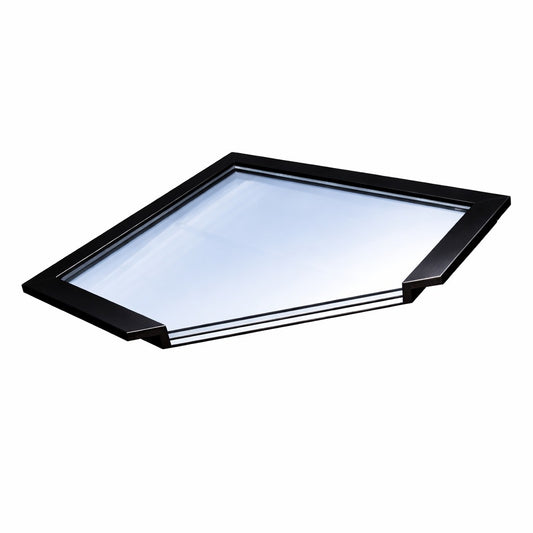
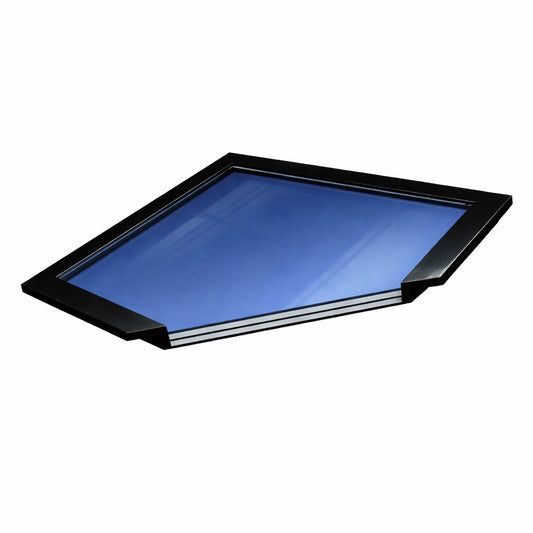
For standard units – the top pane
would have a black 100mm overhang all around the top pane. This would then make the overall size of the top pane 1200mm x 1200mm in this example. We can increase the size of the overhang if required, if the up-stand width is wider. This may come at an additional cost.
Preparing Your Roof
Structural glazing silicone is used to
bond the double/triple glazed seal units onto the roof pane to form a roof
light. The roof-light IGU is simply secured onto the timber kerb built by your roofer or builder as part of the roof construction.
The timber upstand should protrude
150mm above the roof. The pitch should be 5 degrees, which would be sufficient enough to allow water to flow down and self-clean.
Installing the roof light
The final step to finish the roof before installing the roof light is to apply your roof covering up to the side of the up-stand to make it weather proof as illustrated below.
The timber up-stand should protrude atleast 150mm above the roof and the pitch should be 5 degrees, sufficient to allow water to flow down. Please note self clean option only works effectively at pitches of 10 degrees or more. Before sealing the product
with the silicone, water can be applied to test the water flow. If pooling
occurs, a higher pitch may be required.
Thr bottom pane should be supported on all 4 sides once set it place, the support batten should be fitted
to the underside of the rooflight with structural glazing tape. The glazing tape then supports the main weight from underneath the rooflight
Apply adequate compatible low modulus silicone as per silicone suppliers data sheet to the top
of the up-stand firmly placing the roof-light onto the up-stand. Pressure should be applied all round the 100mm overhang to ensure the silicone spreads and seals any gaps and then finish off the silicone all around with silicone tool. Excess silicone should then be wiped away with a finishing tool. Dowell 791 low modulus weather proofing silicone and Dowell 895 structural sealant are
compatible with Dowell 3363. Setting blocks can be used to achieve sealant
thickness required
At this stage the bottom and top panes should be supported. Sealants compatible with the top of the up-stand, glass, setting blocks and Dowell 3363 silicone should be used. Some sealant suppliers may require primer to be applied to the surface.
Please note all roof lights are made to order and sizes can not be changed once glass is cut or toughened. We recommend the specification, sizes and instructions are reviewed and understood by the installer before proceeding with the order.